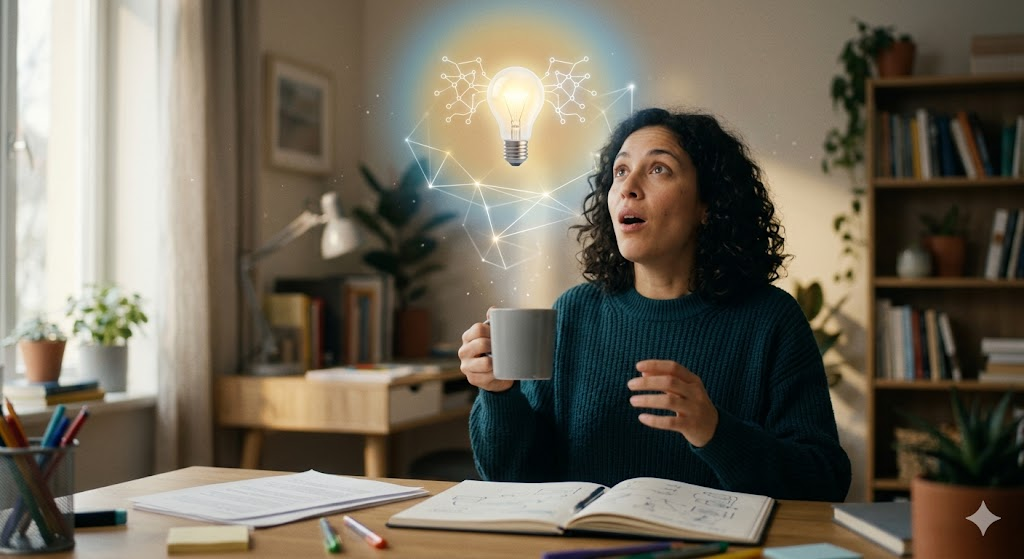
Have you ever been stuck on a problem for hours, only for the answer to pop into your head while you are washing dishes? That sudden “lightbulb” moment is what experts call insight. In the simplest terms, the insight psychology definition refers to a sudden and often unexpected resolution of a problem. It is that “Aha!” or “Eureka!” moment where the pieces of a puzzle finally click together. Unlike trial and error, where you test different ideas one by one, insight happens all at once. It changes how you see a situation and gives you a clear path forward.
Psychologists study this because it is a unique way our brains process information. It involves a shift in perspective. You aren’t just getting more information; you are looking at the information you already have in a brand-new way. This process is essential for creativity, learning, and solving complex life challenges. Understanding the insight psychology definition helps us realize that our brains are constantly working in the background, even when we aren’t actively thinking about a specific task.
The History of Insight in Mental Science
The study of insight goes back to the early 20th century with Gestalt psychology. Researchers like Wolfgang Köhler noticed that animals and humans don’t always learn through slow habits. Sometimes, they just “get it.” Köhler famously studied chimpanzees who figured out how to use sticks to reach bananas. They didn’t just guess; they sat quietly, thought about the tools, and then performed the solution in one smooth motion. This helped form the foundation of the insight psychology definition we use today.
Over the years, we have moved from watching monkeys to looking at human brain waves. Scientists have found that right before an insight happens, there is a specific type of brain activity. Your brain actually quiets down for a split second—kind of like it’s holding its breath—before the “Aha!” moment hits. This history shows us that insight is a natural, biological process. It is a built-in feature of the human mind designed to help us overcome obstacles that logic alone cannot solve.
How the Brain Creates an “Aha!” Moment
The biological side of the insight psychology definition is truly fascinating. It usually involves the right hemisphere of the brain, which is great at seeing the “big picture” and making distant connections. When you face a tough problem, your left brain tries to use logic and known rules. If those don’t work, you might feel frustrated. This is actually a good sign! It means your brain is moving the problem over to the right side to look for creative links.
When the solution arrives, your brain releases a burst of dopamine. This is why a sudden realization feels so good and exciting. It’s a reward for solving the mystery. The insight psychology definition isn’t just about the thought itself; it’s about the physical sensation of clarity. Researchers using fMRI scans can see the temporal lobe lighting up during these moments. This proves that “trusting your gut” or having a flash of genius is actually a very high-level neurological event happening inside your skull.
Insight vs. Trial and Error: What’s the Difference?
To really grasp the insight psychology definition, we have to compare it to other ways of thinking. Trial and error is like walking through a dark room and feeling the walls until you find the door. It is slow, repetitive, and requires a lot of physical or mental effort. You make mistakes, learn from them, and try again. While this is useful for many tasks, it isn’t very efficient for complex problems that require a totally new approach.
On the other hand, insight is like someone suddenly flipping on the light switch. You don’t have to feel the walls anymore because you can see exactly where the door is. In the context of the insight psychology definition, trial and error is linear (Step A to Step B), while insight is non-linear. You jump from “stuck” to “solved” in a heartbeat. Both are important for learning, but insight is what leads to major breakthroughs in science, art, and personal growth.
The Four Stages of the Insight Process
Most psychologists agree that insight doesn’t just happen out of nowhere. It follows a specific four-stage pattern. First is Preparation, where you gather facts and try to solve the problem using logic. Second is Incubation, where you step away and let your subconscious mind take over. This is why many people have insights in the shower or while out for a walk. Your brain is still working, even if you aren’t focused on the goal.
The third stage is Illumination, which is the core of the insight psychology definition. This is the “Aha!” moment itself. The fourth and final stage is Verification. This is where you test your new idea to make sure it actually works in the real world. You can’t have the “Aha!” without the “Preparation” that came before it. By understanding these stages, you can actually set yourself up for more frequent breakthroughs by giving yourself time to rest and incubate your ideas.
Quick Comparison Table: Insight vs. Logic
| Feature | Insight Thinking | Logical/Linear Thinking |
| Speed | Sudden and Instant | Slow and Step-by-Step |
| Feeling | “Aha!” Moment | Steady Progress |
| Process | Seeing the “Big Picture” | Following Rules/Patterns |
| Best For | Creative Problems | Routine Tasks |
| Brain Side | Mostly Right Hemisphere | Mostly Left Hemisphere |
Real-Life Examples of Insight in Action
Let’s look at some stories to better understand the insight psychology definition. Think of Archimedes in his bathtub. He was trying to figure out how to measure the volume of a crown. When he stepped into the tub and saw the water rise, he suddenly realized that the water displaced was equal to his body’s volume. He shouted “Eureka!” because the solution hit him all at once. He didn’t do math for hours to find that specific connection; he just saw it.
In everyday life, you might experience this when you are trying to remember a person’s name. You struggle and struggle, but nothing comes to mind. Then, two hours later, while you are making a sandwich, the name “Sarah” just pops into your head. That is a small version of the insight psychology definition. It shows that your mind is a powerful engine that continues to search for answers even when you are busy doing something else.
Why We Get Stuck: Mental Sets and Fixation
Sometimes we can’t reach that “Aha!” moment because of something called “functional fixedness.” This is a big part of the insight psychology definition. It happens when we can only see an object for its usual purpose. For example, if you need to screw in a loose nail but don’t have a screwdriver, you might get stuck. But if you have an insight, you might realize you can use the edge of a coin or a butter knife to do the job.
Being “stuck” often means your brain is trapped in a mental set. You are trying the same old methods that worked in the past, even though they don’t work now. To trigger the insight psychology definition in your own life, you have to break these sets. You have to ask, “What else could this be?” or “How would a child look at this?” Breaking through these mental walls is the only way to let the creative light of insight shine through.
Can You Trigger More Insights?
The good news is that you can actually train your brain to be more “insight-prone.” Since the insight psychology definition relies on a relaxed state of mind, the best thing you can do is take breaks. If you are frustrated with a project, walk away. Practice mindfulness or meditation to quiet the “noise” in your left brain. This creates a quiet space where your right brain can start making those distant, creative connections that lead to breakthroughs.
Another tip is to stay curious about different topics. The more diverse information you have in your head, the more “dots” your brain has to connect. People who read widely or have many hobbies often find it easier to experience the insight psychology definition because their brains are used to seeing patterns across different fields. Don’t just focus on your one problem; let your mind wander and explore the world around you.
Insight in Therapy and Personal Growth
In clinical settings, the insight psychology definition takes on a slightly different meaning. It refers to a person’s ability to understand their own mental and emotional processes. When someone in therapy suddenly realizes why they act a certain way—perhaps due to a childhood memory—that is a powerful moment of insight. It is the bridge between knowing you have a problem and actually having the power to change it.
This kind of “emotional insight” is life-changing. It’s not just solving a puzzle; it’s solving yourself. When a person gains this kind of clarity, they often feel a huge sense of relief. Just like the scientific insight psychology definition, emotional insight is sudden and shifts your entire perspective. It allows you to move forward with a new “map” of your personality, making it easier to build healthier habits and happier relationships.
The Role of Creativity and Innovation
Without insight, human progress would be much slower. Every major invention, from the lightbulb to the internet, started with a moment that fits the insight psychology definition. Inventors often spend years studying a problem, only to have the final solution arrive during a dream or a moment of relaxation. This is why companies now build “break rooms” and creative spaces—they know that hard work alone isn’t enough for big ideas.
Creative people often describe themselves as “channels” for these ideas, but it’s actually just their brains doing what the insight psychology definition describes. They are excellent at the “incubation” phase. They allow themselves to be bored and to daydream. If you want to be more innovative, stop filling every second of your day with phone screens and distractions. Give your brain the silence it needs to “click” into place.
Conclusion
Understanding the insight psychology definition is like having a key to your own mind. It teaches us that we aren’t just logic machines; we are creative beings capable of amazing leaps of thought. While we can’t always force an “Aha!” moment to happen, we can create the perfect environment for it. By working hard, resting often, and staying open to new perspectives, we invite insight to visit us more frequently.
Next time you feel stuck, remember that your brain is likely just in the “incubation” phase. Don’t give up! Take a walk, grab a glass of water, and let your subconscious do the heavy lifting. The solution is often right around the corner, waiting for that perfect moment to reveal itself. Embrace the power of the insight psychology definition and watch how it transforms your problem-solving, your work, and your life.
Frequently Asked Questions
1. What is the simplest definition of insight in psychology?
The insight psychology definition is the sudden discovery of a solution to a problem after a period of being stuck. It is commonly known as an “Aha!” or “Eureka!” moment.
2. How does insight differ from regular learning?
Regular learning is often slow and builds up over time (like learning to play piano). Insight is instant and involves a sudden shift in how you see the entire situation.
3. Why do insights often happen in the shower?
Insights happen when your mind is relaxed. While showering, you aren’t focused on a specific task, which allows your brain to make creative connections it can’t make when you are stressed.
4. Can children experience insight?
Yes! Children experience the insight psychology definition frequently as they learn how the world works. Their brains are very flexible, making them great at finding creative solutions to play-time puzzles.
5. Is insight related to IQ?
While a higher IQ can help with gathering information (Preparation), insight is more closely linked to creativity and “cognitive flexibility”—the ability to see things from multiple angles.
6. Can I improve my ability to have insights?
Yes. By practicing mindfulness, taking regular breaks from “deep work,” and exposing yourself to new ideas, you can make your brain more likely to experience the insight psychology definition.