The backyard pool has evolved far beyond a simple summer luxury.
In 2026, pool owners are embracing robotic solutions that deliver hands-free maintenance, energy efficiency, and seamless integration with home automation systems.
Industry analysts project the global robotic pool cleaner market will exceed $3.5 billion by 2028, driven by rising labor costs, increasing pool ownership in sunbelt regions, and growing demand for smart home products.
The shift toward autonomous pool maintenance marks a fundamental change in how homeowners approach pool care.
Manual tasks such as skimming, chemical testing, and filter cleaning once required significant weekly effort.
Today, robotics technology, solar power, and advanced sensors are transforming these chores into automated processes that require minimal human intervention.
AI-Powered Navigation and Mapping
One of the most significant breakthroughs in 2026 is the adoption of artificial intelligence for pool navigation.
Modern robotic cleaners use AI vision systems, depth-sensing technology, and machine learning algorithms to create dynamic maps of pool geometry.
Unlike earlier models that relied on random movement patterns, these intelligent cleaners analyze pool interiors in real time, calculating the most efficient routes for complete coverage. This capability eliminates redundant cleaning passes and missed spots.
Robots can now distinguish between floor, walls, steps, and waterline areas, adjusting their cleaning behavior based on the surface type.
Some systems use optical sensors and sonar to detect debris types and adapt suction power accordingly, ensuring fine particles and larger debris are handled appropriately.
Adaptive Cleaning Behavior
Machine learning enables robotic cleaners to improve over time.
By analyzing past cleaning cycles, water clarity data, and flow dynamics, these systems adjust their intensity and patterns for optimal performance.
A robot that learns where leaves typically accumulate can prioritize those zones during scheduled cleanings. This intelligence reduces energy consumption while improving cleaning outcomes.
Cordless Freedom and Battery Innovation
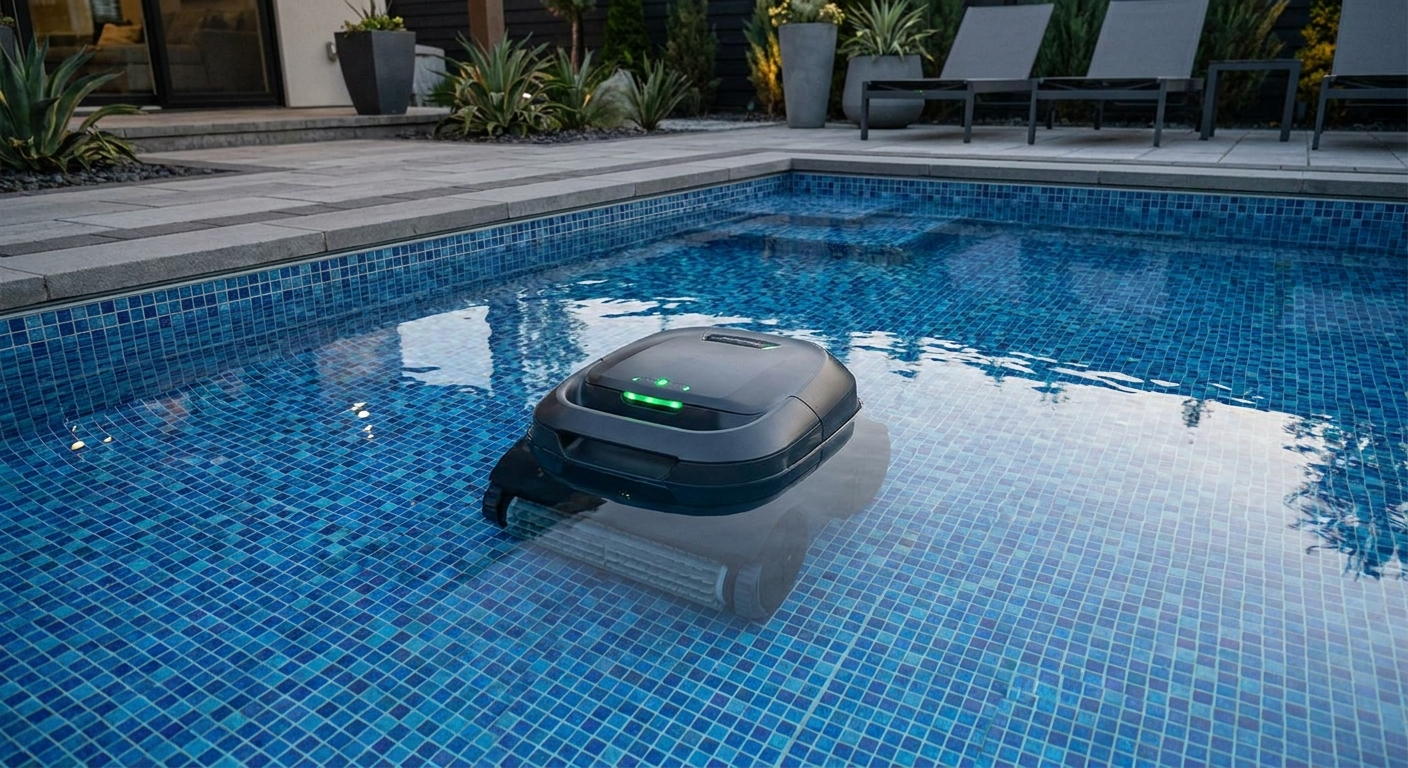
The transition from corded to cordless designs represents one of the most visible shifts in the market.
Advanced lithium-ion batteries now deliver 120 to 180 minutes of runtime per charge, with some models offering up to 5 hours of continuous floor cleaning.
Fast charging systems reduce downtime between cycles, and smart energy management ensures consistent suction performance even as battery levels drop.
This cordless freedom eliminates tangled cables and allows robots to navigate freely around pool obstacles.
Homeowners can simply place the unit in the water and let it work without worrying about power cord reach or entanglement with ladders and pool covers.
Solar-Powered Surface Skimming
Surface debris — leaves, bugs, pollen, and grass clippings — is a daily nuisance for pool owners.
If left floating, this material eventually sinks and becomes a larger problem.
Solar-powered surface skimmers address this issue by operating continuously without cords or battery charging.
These devices use solar panels to power their motors, skimming the water surface 24 hours a day to prevent debris from sinking.
Dual-mode operation allows users to choose between energy-efficient periodic cleaning and continuous intense operation depending on seasonal debris levels.
This approach not only keeps the pool looking clean but also reduces the load on underwater robotic cleaners and filtration systems.
Water Chemistry Integration
In 2026, robotic cleaners are moving beyond simple debris collection.
Advanced models now interface with water chemistry sensors to monitor pH, oxidation-reduction potential, temperature, and turbidity.
This creates a closed-loop maintenance workflow where cleaning and sanitation work together.
When turbidity spikes, the robot can perform targeted passes to remove suspended solids. Temperature shifts help adjust runtime for optimal performance.
This integration reduces sanitizer demand by removing organic material earlier, stabilizes water chemistry, and minimizes the need for corrective chemical dosing.
Smart Connectivity and Home Integration
Modern robotic pool cleaners connect to Wi-Fi and Bluetooth networks, enabling remote control and scheduling through smartphone apps.
Users can start or pause cleaning cycles, view diagnostics, and receive alerts about filter maintenance or water chemistry anomalies from anywhere. Integration with smart home ecosystems is becoming standard.
Voice control through platforms like Google Home and Amazon Alexa allows homeowners to activate cleaning cycles or check pool status with simple commands.
Cloud connectivity enables firmware updates and performance tracking, ensuring the robot continues to improve over time.
Energy Efficiency and Sustainability
Environmental consciousness influences purchase decisions in 2026.
AI-powered routing reduces energy consumption by 20 to 50 percent compared to legacy algorithms, since robots avoid unnecessary travel and tune power usage based on task complexity.
More efficient cleaning also reduces strain on pool filtration systems, lowering pump runtime and overall energy costs. Solar-assisted charging and low-voltage motors further improve sustainability.
Manufacturers are using recyclable materials and eco-friendly packaging, while advanced filter systems minimize water waste and microplastic release.
These features appeal to eco-minded consumers seeking to reduce their carbon footprint while maintaining a pristine pool.
The Role of Smart Cleaner Trends in 2026
The rapid evolution of pool cleaning technology reflects broader changes in consumer expectations.
Homeowners want equipment that saves time, reduces effort, and integrates smoothly into their connected lifestyles.
The latest smart pool cleaner trends demonstrate how AI, cordless design, and solar innovation are converging to create truly autonomous maintenance solutions.
Commercial operators also benefit from these advances. Hotels, fitness centers, and community pools report reduced staffing burden and improved operational predictability with AI-driven cleaners. These systems maintain water clarity continuously, perform targeted cleaning during low usage periods, and generate compliance logs for health inspections.
Looking Ahead
The next generation of pool robotics will likely include autonomous chemistry adjustment based on debris load and sanitizer demand, predictive maintenance scheduling using historical data, and multi-robot coordination for large or commercial pools.
As AI and the Internet of Things continue to converge, the concept of set-and-forget pool care becomes increasingly achievable.
For pool owners evaluating their options in 2026, key considerations include navigation intelligence, battery runtime, filtration capacity, and compatibility with existing smart home systems.
With technology advancing rapidly and prices becoming more accessible, the era of hands-free pool maintenance has firmly arrived.